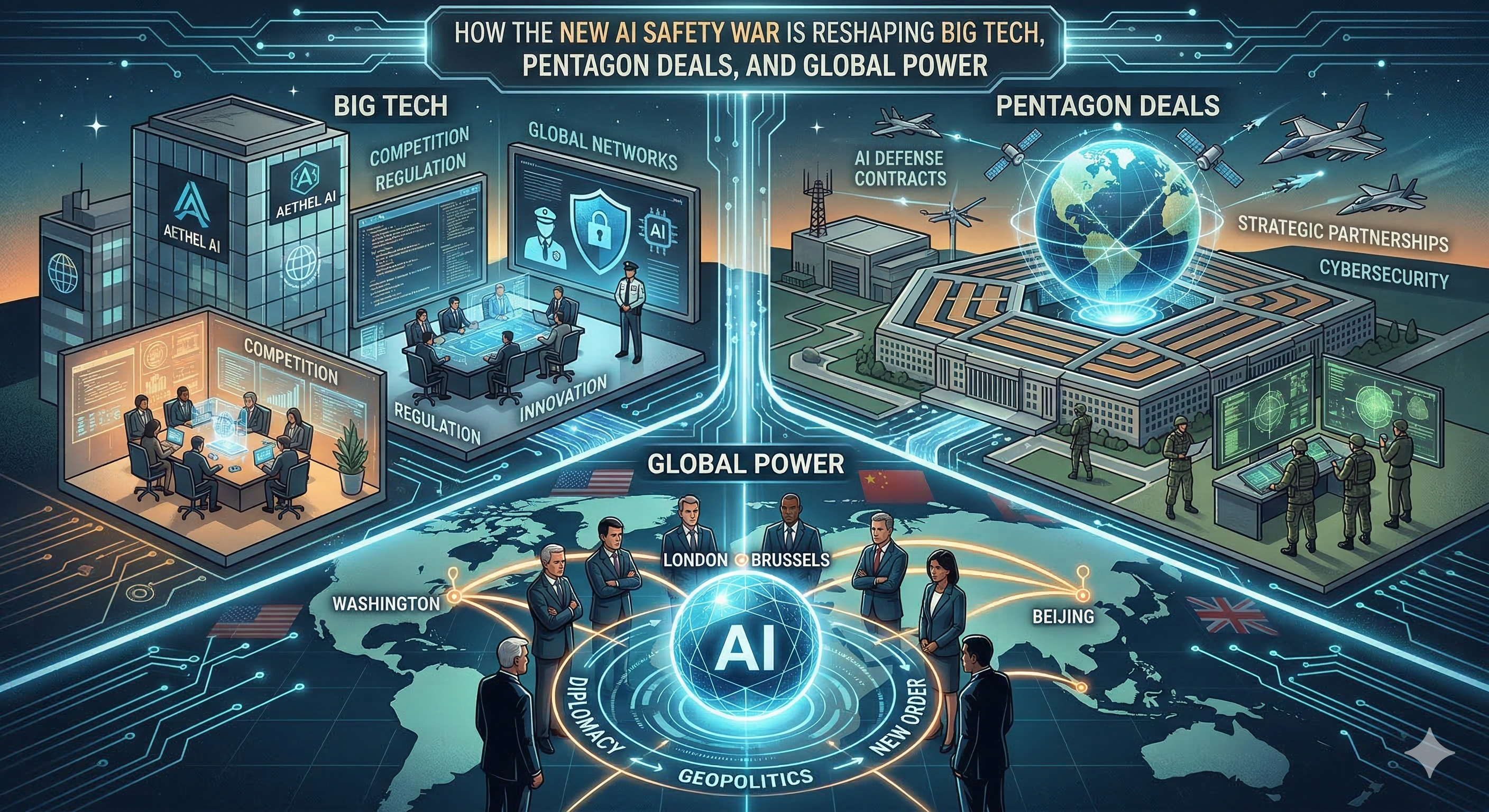
How the New AI Safety War Is Reshaping Big Tech, Pentagon Deals, and Global Power
The Shot Heard Across Silicon Valley
On March 5, 2026, the United States Department of Defense did something it has never done to an American company before. It officially labeled Anthropic — a leading frontier AI firm — a supply chain risk, making it the first American company to ever receive that designation. TechCrunch Let that sink in. A label historically reserved for hostile foreign actors like Huawei was now being applied to a San Francisco AI startup whose only offense was refusing to let the military do whatever it wanted with its technology. This isn't just a corporate dispute. It's a defining moment for the entire AI industry, the future of democratic oversight, and the global race to control the most powerful technology humanity has ever built.
What Actually Happened
The backstory is less complicated than the fallout. Anthropic — the only AI company deployed on the Pentagon's classified networks — reached an impasse with the Trump administration over two firm limits: the company wanted explicit bans preventing its Claude model from being used for mass surveillance of Americans or powering fully autonomous weapons. CBS News The Pentagon's position? It needed Claude for "all lawful purposes" — full stop. No private vendor gets to dictate terms to the U.S. military. Trump and Defense Secretary Pete Hegseth announced a series of threatened punishments on the eve of the Iran war, after Anthropic CEO Dario Amodei refused to back down. NPR Hours after negotiations collapsed, OpenAI announced a deal to effectively replace Anthropic with ChatGPT in classified military environments. NPR The timing wasn't subtle.
The Two Red Lines That Started a War
Understand the core of Amodei's argument and you understand why this fight matters so much. On mass domestic surveillance, Amodei wrote that it would be "incompatible with democratic values." On fully autonomous weapons, he stated that today's frontier AI models are "simply not reliable enough" yet. CBS News These aren't fringe positions. They reflect mainstream AI safety consensus. And yet, the U.S. government's response was to treat Anthropic like a foreign adversary. Federal codes define supply chain risk as risk that "an adversary may sabotage, maliciously introduce unwanted function, or otherwise subvert" a system. Northeastern Global News Anthropic didn't sabotage anything. It drew ethical limits. The fact that this distinction was ignored by the Pentagon tells you everything about how Washington currently views AI governance — as a compliance problem, not a values problem.
The Legal Battle Now Underway
Anthropic didn't fold. On Monday, March 9, the company sued the Pentagon, alleging the designation violates its First Amendment rights and exceeds the government's authority. Axios The company filed in two separate jurisdictions simultaneously. Anthropic has asked the court to vacate the supply chain risk designation and grant a stay. CFO Krishna Rao warned the financial stakes are enormous — the government's actions "could reduce Anthropic's 2026 revenue by multiple billions of dollars." CNBC The legal argument is sharp. Anthropic argues that Congress required the department to use the "least restrictive means" to protect the government and mitigate supply chain risk — not punish a supplier for protected speech. Axios Whether courts agree is another matter. But the precedent being set here is dangerous regardless of who wins.
How Big Tech Is Playing Both Sides
Here's where it gets commercially interesting for anyone watching enterprise AI adoption in 2026. Microsoft studied the Pentagon's designation and concluded that Anthropic products, including Claude, can remain available through platforms like M365, GitHub, and Microsoft's AI Foundry for all non-defense-related projects. Google and Amazon released similar statements. CNN So the three largest cloud providers are essentially ring-fencing Anthropic from defense work while keeping their commercial integrations intact. Smart legal maneuvering. But it also reveals the uncomfortable truth — hyperscalers have no interest in being collateral damage in a political feud between an AI startup and the White House. Meanwhile, OpenAI signed its deal with the DOD hours after Anthropic was blacklisted CNBC — positioning itself as the compliant alternative. Some employees have already raised concerns internally about the deal's open-ended "all lawful purposes" language. The same ethical trap Anthropic refused to step into.
The Geopolitical Stakes Are Enormous
Step back from the legal drama. What does this episode signal about the global AI arms race? The U.S. military is relying on Claude in its Iran campaign, where American forces are using AI tools to quickly manage data for their operations. Claude is one of the main tools installed in Palantir's Maven Smart System, which military operators in the Middle East rely on. TechCrunch And yet, the Pentagon simultaneously designated Claude's maker a national security threat. The cognitive dissonance is staggering. This creates a strategic vacuum. Usama Fayyad, senior vice provost for AI at Northeastern University, warned the escalation against Anthropic will "cause major economic, scientific and engineering damage as everyone freezes in fear and the U.S. falls behind other countries pending resolution." Northeastern Global News China is watching. Europe is watching. Every allied government investing in sovereign AI is taking notes on what happens when the U.S. treats its own AI innovators as adversaries.
Global AI Safety Frameworks: Racing to Catch Up
While Washington fights with its own AI companies, governments across North America, Europe, and Asia are accelerating work on regulatory frameworks designed to govern advanced AI systems, focusing on transparency, safety testing, and responsible deployment. wbn The irony is sharp. The very "global AI safety frameworks" being drafted at the policy level are premised on the idea that AI labs should be encouraged to build ethical guardrails into their products. Anthropic did exactly that — and got punished for it. This contradiction will define AI policy debates for years. Can governments simultaneously demand responsible AI development while also demanding unrestricted access to AI capabilities? That tension has no clean resolution.
What This Means for Enterprise AI Adoption in 2026
For tech founders and enterprise decision-makers, the commercial implications are concrete.
- Defense tech is no longer a neutral category. Any company integrating AI into government workflows must now factor in political exposure, not just technical performance.
- The OpenAI "compliance play" carries hidden risk. Signing broad "all lawful purposes" agreements may look smart today, but it creates long-term reputational liability if those tools are used in ways employees and customers consider unethical.
- Anthropic's consumer surge is real signal. The company saw more than a million new sign-ups per day during the dispute week, climbing past ChatGPT and Gemini as the top AI app in more than 20 countries on Apple's App Store. NPR Ethics, when visible, turns into brand equity.
- Cloud providers are the new neutral ground. Microsoft, Google, and Amazon have successfully positioned themselves as platforms above the political fray — at least for now.
The Anthropic Question Is Really the AI Question
Strip away the headlines. At its core, this story is asking a single question that the entire AI industry will have to answer in the next five years: Who gets to decide how the most powerful AI systems in the world are used? Dozens of scientists and researchers at OpenAI and Google DeepMind — Anthropic's two biggest competitors — filed an amicus brief supporting the company, arguing the supply chain risk designation could harm U.S. competitiveness and hamper public discussion about AI risks and benefits. CNN Even rivals rallied around the principle. That's how high the stakes are. Former Trump White House AI adviser Dean Ball called the designation a "death rattle" of the American republic, arguing the government had abandoned strategic clarity in favor of "thuggish" tribalism that treats domestic innovators worse than foreign adversaries. Northeastern Global News Strong words. But not wrong.
The Bigger Picture
The AI safety war isn't really about Anthropic. It's about whether democratic governments will govern AI through transparent frameworks, or through the blunt instrument of contract leverage and political pressure. The answer to that question will shape not just which companies win defense contracts. It will shape the architecture of AI systems that run critical infrastructure, manage battlefield decisions, and process the private data of billions of people. Enterprise AI adoption is accelerating — across analytics, research, customer service operations, and now active military use. wbn The speed of deployment is outrunning the speed of governance. Every week that passes without clear legal frameworks is another week where the rules of this new war are being written in real time, by whoever has the most leverage at that moment. Right now, that's not a reassuring thought.


0 Comments
Loading comments...
Leave a Reply